This page is for the attorney who wants to understand the engineering before making an account. If you're in a hurry, the short version is: I measure everything Google measures, on every firm in Greater Seattle, every 72 hours, and I show you where you stand against the firms you're really competing with. If you'd like that with more detail, read on.
01
What I measure
For each of the 2,704 law firms in Greater Seattle, I run roughly 52 distinct measurements on a rolling schedule. Some refresh weekly. Some monthly. Some twice a week. The result is a continuously updated picture of where every firm stands, on every surface Google ranks on, against every signal Google weights.
A few categories, in plain English:
The speed of your server, and the speed of the code your site is built on — both measured from real Chrome user data, not lab simulations. Your backlinks: who is linking to you, how authoritative those domains are, who started linking to you this month and who stopped. Your Google Business Profile: every review, every owner reply, every Google Post, refreshed weekly. Your rankings on a grid of points spread across your entire service area, so you can see how your visibility changes as a prospective client moves through the geography. Your firm's entry in Google's Enterprise Knowledge Graph — the database that increasingly decides whether the AI models cite you when someone asks ChatGPT for a lawyer.
I don't measure all of this because I'm trying to be impressive. I measure all of it because Google does, and the only way to know what's moving your rankings is to measure everything that could be.
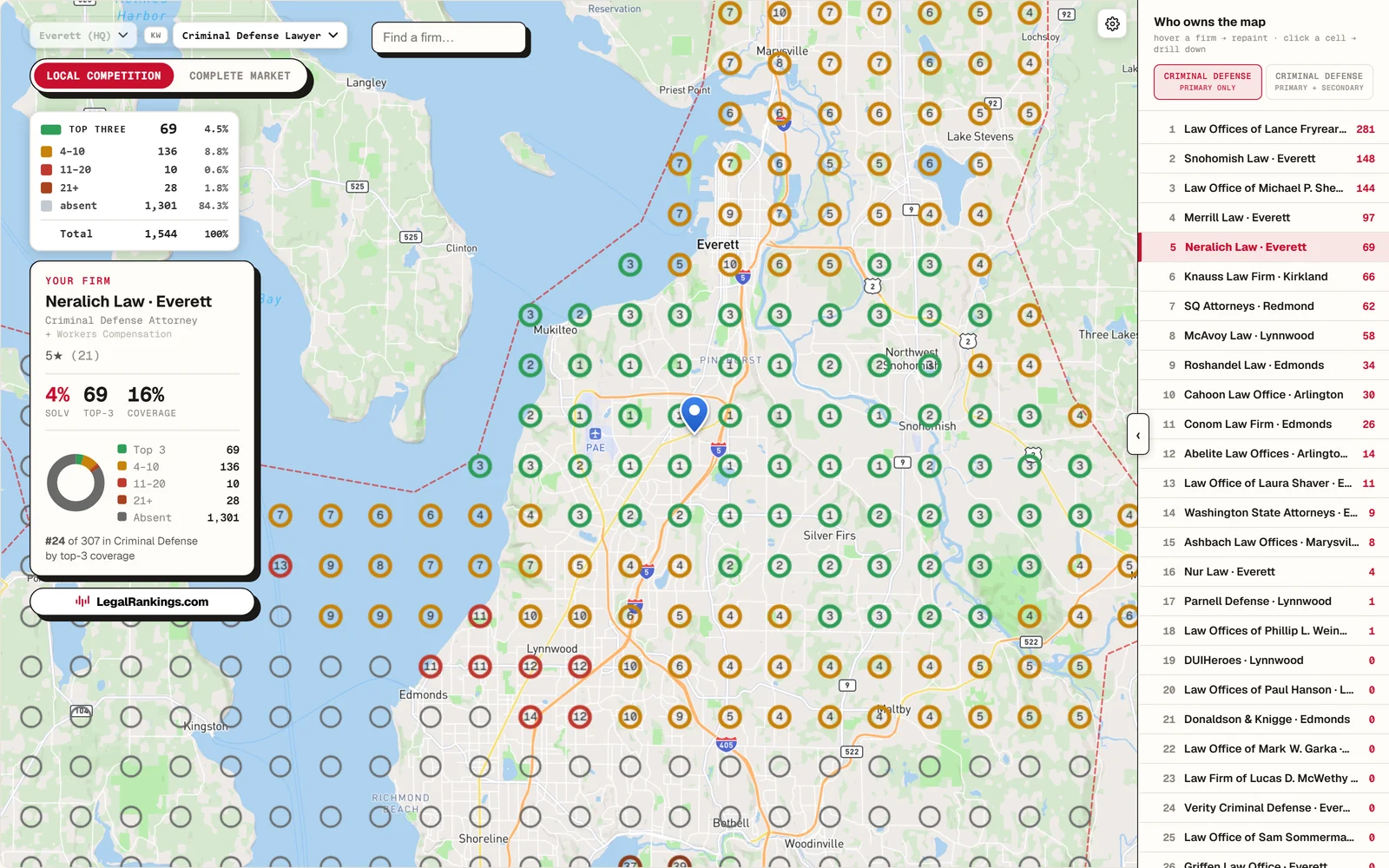
Visibility measured on a grid of points across your whole service area — not just outside your own front door.
02
Technical SEO, explained
Technical SEO matters more than most people think. It is the part of the discipline that has nothing to do with marketing and everything to do with engineering — and it is the part most agencies serving the legal market either don't understand or quietly skip.
It is not content marketing. It is not link building. It is not the monthly report. It is the layer underneath all of those — the part that determines whether anything you do above it produces results.
There are four pieces to it.
01
The ranking signals themselves
Google's algorithm weights hundreds of factors. The 52 I track per firm are the ones that move position in legal search specifically — page experience scores from Google's own PageSpeed Insights field data, backlink quality and velocity from eight separate authority endpoints, entity consistency in Google's Knowledge Graph, content depth, freshness, mobile rendering, schema implementation, local relevance, and several dozen more. Knowing which signals matter for your practice area, in your geography, is the foundation. Most agencies guess at this. The data answers it.
02
The surfaces Google ranks on
A keyword does not have one position. It has positions across desktop organic, mobile, the local 3-pack, the expanded Local Finder, the AI Overview, and a grid of points spread across your entire service area at roughly 1.3-mile spacing. Those positions diverge — sometimes dramatically. A firm that ranks well in the visible 3-pack near its own office often drops out of the pack entirely a few miles away in the same service area. Reports that average across surfaces give you a number. Surface-by-surface measurement gives you the truth, and tells you exactly where you're competitive and where you aren't.
03
The infrastructure underneath your own site
Page load speed. Core Web Vitals from real Chrome users, not lab simulations. Indexability. Schema markup. Canonical tags. Crawl budget. Mobile rendering. Domain age and registration history. The technologies your site is built on. The technical health of your site is itself a ranking signal, and a poorly built site puts a ceiling on everything else you do. Most legal websites I scan have at least three significant technical issues their agency has never mentioned — sometimes because the agency doesn't see them, sometimes because fixing them isn't on the agency's price list.
04
The competitive field, measured continuously
This is the piece almost nobody does. Ranking signals only matter relative to the firms competing with you. Your site speed matters relative to theirs. Your backlink profile matters relative to theirs. Your review velocity matters relative to theirs. Your Knowledge Graph entity matters relative to theirs — and that last one increasingly decides whether the AI models cite you when someone asks ChatGPT or Google's AI Overview for a lawyer in your city. If your entry in Google's Knowledge Graph isn't clean, the machine can't cite what it can't resolve. No entry, no citation. Most firms have never checked theirs. I check every firm in the market, every week.
Measuring your own signals without measuring the competitive field is half the work, and it's the half that doesn't tell you anything actionable.
03
Why this is different from what your agency does
Your agency almost certainly uses some version of these tools. Most agencies have a Semrush license or an Ahrefs subscription, and they look at backlink counts and rank trackers and produce reports.
The difference is scope and cadence. An agency tracking five competitors per client, refreshed monthly, produces a snapshot. A pipeline running on every firm in the market, refreshed every 72 hours, produces a time series — a continuously updated view of who's moving where, and why. The snapshot tells you a number. The time series tells you the truth.
That's the engineering difference. It's also why no agency in this market is producing what I produce — it isn't a question of tools, it's a question of how much data you're willing to collect and how often you're willing to refresh it. The answer for me is “everything,” and “continuously.”
04
What you do with all of this
You log in and look. The data is already there. Your firm, every competitor, every signal, every surface, updated to within the last three days.
If your position is strong, you'll see it across the board — and you'll know your current marketing is working without having to take anyone's word for it. If there are gaps, you'll see them named specifically: which competitors are ahead of you, on which signals, by how much, and what closing the gap would take. Then we talk about which gaps are worth closing first.
There is no charge to look.
There is no charge to look
Now make an account and see your own numbers.
Three fields. Within a business day I'll have your firm configured in the dataset and email you the login link.