How I prove it · Legal Rankings
I show you which work moved which number.
Most SEO ends with a sentence: “Your rankings are up.” It is usually even true. It is also nearly useless — because no one can tell you which of the month's work actually caused it. Was it the new page? The title you rewrote? A competitor slipping three spots on their own? You are asked to take the trend on faith.
I don't work that way. When you engage me to close the gaps the data found, I prove the work — change by change, on your own search data. Here is how.
I connect to your Search Console
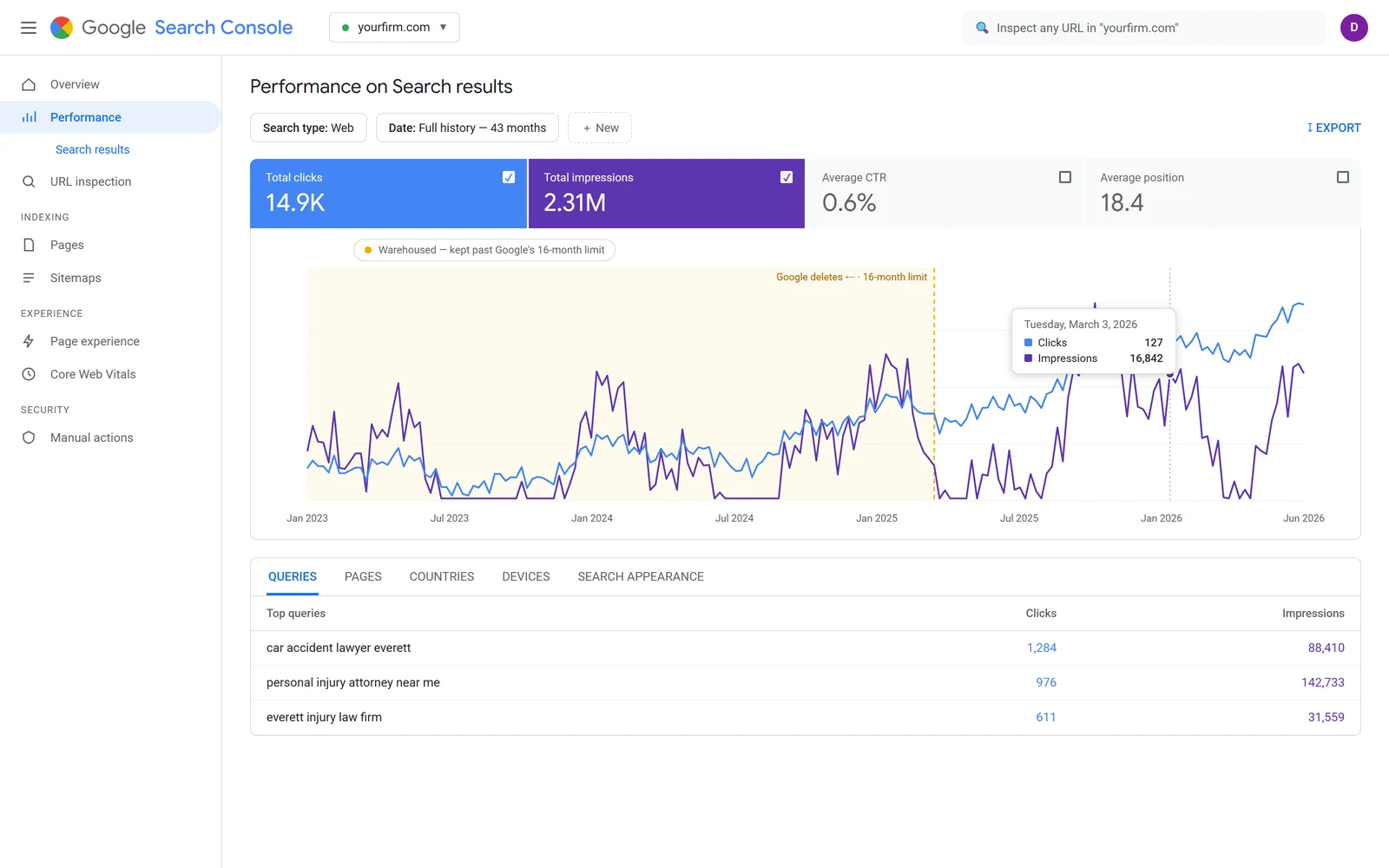
It starts with a single read-only invitation to your Google Search Console. From that moment I am warehousing your real search data — every query you appear for, every page, every day, with the exact position, clicks, and impressions behind it.
And I keep all of it. Google discards your history after about sixteen months. I keep the full record from the day we connect, so the timeline only grows. The longer we work together, the more there is to prove.
And to what they do once they arrive
Search Console shows how you appear in search; it stops at the click. Analytics shows what happens next — which organic visitors stay, which pages they read, which ones reach out.
But GA4 keeps that detail for just two months by default — fourteen at the most — and downsamples and gates the deeper reports on top of that, unless someone exports the raw events to a warehouse. Almost no one does. I do it on day one — every event, full-resolution, kept for good — so the click and what it became sit on the same timeline.
I log every change I make
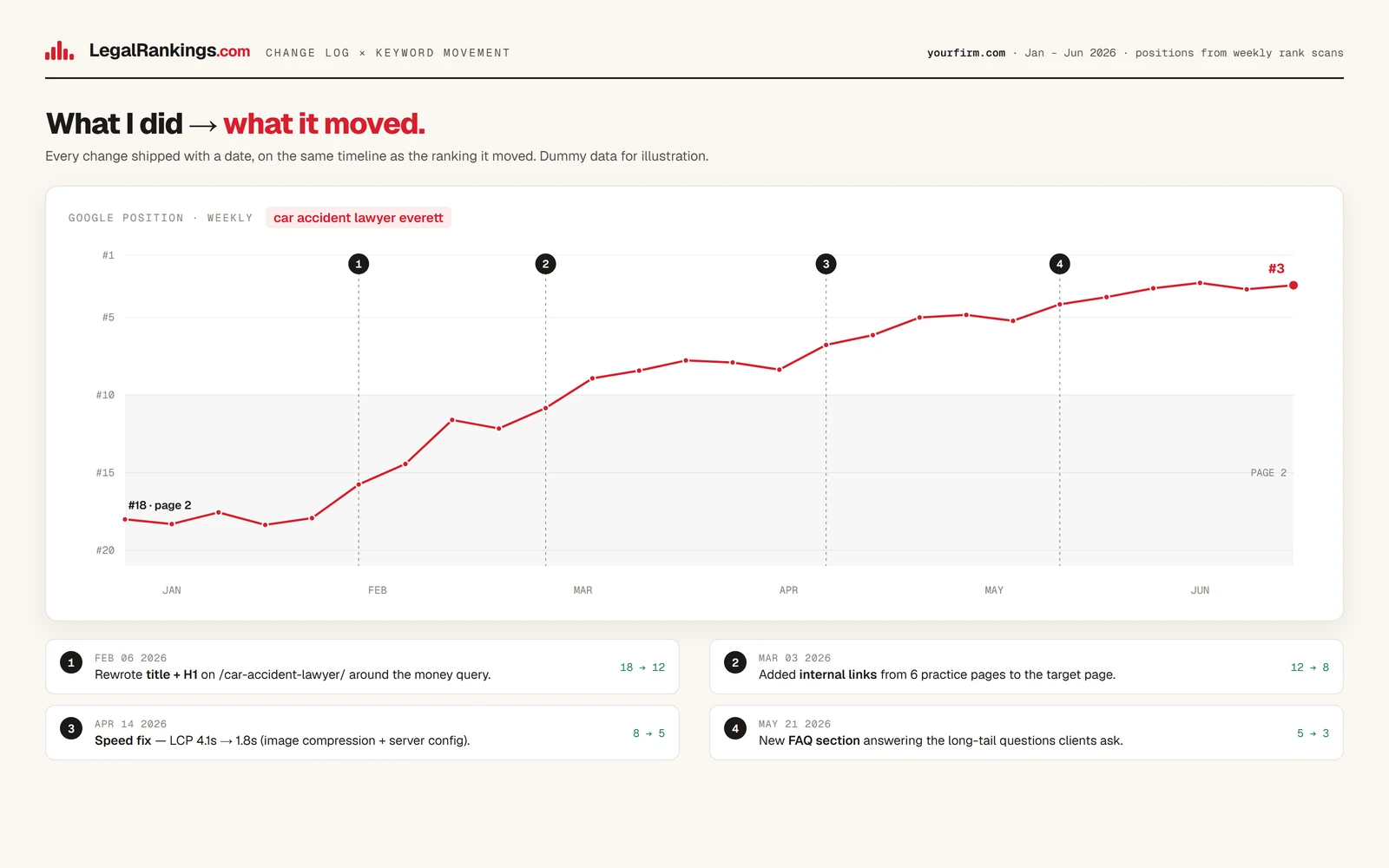
Every change I make to your site goes into the record, with the date I made it: the page I rewrote, the title and headings I sharpened, the internal links I added, the technical and speed fixes most agencies never get to.
Not a vague “optimization” line in a monthly report. The actual change, on the actual day.
I line the two up
Then I put the two records side by side. This change, on this date — these queries moved, on these pages, by this much.
That is the sentence your current agency cannot say. Not “rankings are up,” but “the work on the fourth moved you from the bottom of page two to the top of page one for the searches that bring you clients.” Cause and effect, on your own data, that you can check yourself.
Off-page, in the same picture
The same goes for what happens off your site. Who links to you, which of your citations are clean, what changed this month — tracked over time and laid against the same timeline, so a gain in authority shows up right next to the movement it produced. It is all one record.
Why your agency can't do this
This is not a tools problem. Your agency can buy the same software I can. The difference is what the software is: a dashboard sitting on top of a sampled snapshot — Search Console itself caps its own report at the top 1,000 rows of your data and discards the rest. A snapshot can show you a number. It cannot show you cause — because it doesn't keep your full history, and it doesn't know what work was done.
What I keep is a time series — your whole search record, continuously, joined to a log of every change made. That takes a data warehouse and the engineering to run it, which is a different discipline than running an SEO retainer. It isn't a question of which tool. It's a question of how much data you're willing to collect, how long you're willing to keep it, and whether you're willing to write down what you did. My answer is all of it, for as long as we work together, and yes.
A few questions worth asking
Before you renew with your current agency — or sign with a new one — ask them this. It's a fair thing to ask anyone you pay every month:
- Do you measure every competitor in my market, or a handful you picked?
- Do you refresh that measurement continuously, or once a month?
- Will you connect to all of my Google Search Console properties, and keep the full history after Google deletes it?
- Do you export and keep my raw GA4 data — or live with GA4's two-month default?
- Do you log every change you make to my site, with dates?
- Can you show me which specific change moved which keyword — or only that “rankings are up”?
- Do you track my backlinks and citations over time — and whether the AI models can even cite my firm?
Most will answer no to nearly all of it. That isn't a knock on them — it's the difference between marketing and engineering. I answer yes to every one, because I built the machine that does it.
Where this ends, and what comes next
This page is about proving the SEO itself — the rankings, the visibility, the search work. Following it all the way through to the phone calls, the intake forms, and the cases that actually close is a deeper kind of attribution, and it means connecting to your call tracking, your CRM, and your ad spend.
That work lives on the other side of the house, at Amicus Data. It's available when you're ready for it, but you don't need it to begin. First you need to know your SEO is real. This is how you'll know.
What you do
Make an account and see where you stand. When you decide to close the gaps, this is how I'll prove the work.
There is no charge to look.